
The independent heating and cooling company across Hampton Roads and coastal Virginia
Heat Pump Running Nonstop in Cold Weather
Your heat pump has been running for hours without shutting off, the house feels cool, and you are wondering if something broke. In cold weather, long run times are often normal. A heat pump that never satisfies the thermostat, or short cycles and blows cool air, is a different story. Here is how to tell the difference and what to do next.
Call (888) 381-2953- A real person answers
- Open 7 days
- Written quote before work starts
Taking calls until 5:00 PM ET
By our service team · vetted by the techs who do this daily
Why long run times are normal below about 35 degrees
A heat pump moves heat from outdoor air into your house, and the colder it gets outside, the less heat is out there to move. On a cold morning across the region, a correctly sized system will run continuously to hold the setpoint. That is the design working, not a failure. The air coming from your vents will also feel cooler than furnace air, usually somewhere in the mid to upper 90s, which is below body temperature. Long, steady operation with the house holding temperature is fine. Continuous operation with the house losing ground is worth a call.
Cause one: thermostat settings and airflow, the cheapest culprits
Start with the inexpensive items. A thermostat set to emergency heat, a programmed setback that jumps five or more degrees at once, or dead batteries will all keep the system chasing a target it cannot reach. Then look at airflow. A loaded filter chokes the indoor coil and drags capacity down. Closed or blocked supply registers in bedrooms do the same thing. Change the filter, open every vent, and set the thermostat to a steady number rather than large swings. If run times settle down over the next day, that was your problem.
Cause two: the outdoor unit and defrost trouble
Heat pumps grow frost on the outdoor coil in cold, damp weather, and they run a defrost cycle every so often to melt it. You will hear a whoosh, see steam, and the fan will stop briefly. That is normal. What is not normal is a coil buried in solid ice, or a unit that never defrosts. Around the coast, salt air corrodes coil fins and sensors, and high water tables mean units sitting in wet ground ice up at the base. Clear leaves, snow and grass clippings from around the cabinet. Do not chip ice off or pour hot water on the coil.
Cause three: refrigerant charge, reversing valve and backup heat
If the basics check out and the house still will not warm, the fault is usually inside the sealed system or the controls. Low refrigerant charge from a leak cuts heating capacity long before it stops the unit entirely. A reversing valve that sticks partway can leave the system running in a mode that does nothing useful. Electric backup heat strips that never energize, or a failed outdoor sensor, will also leave you cold on the worst night. None of that is homeowner territory. Refrigerant and high-voltage circuits need a technician with gauges and meters.
What a technician does that you cannot do from the thermostat
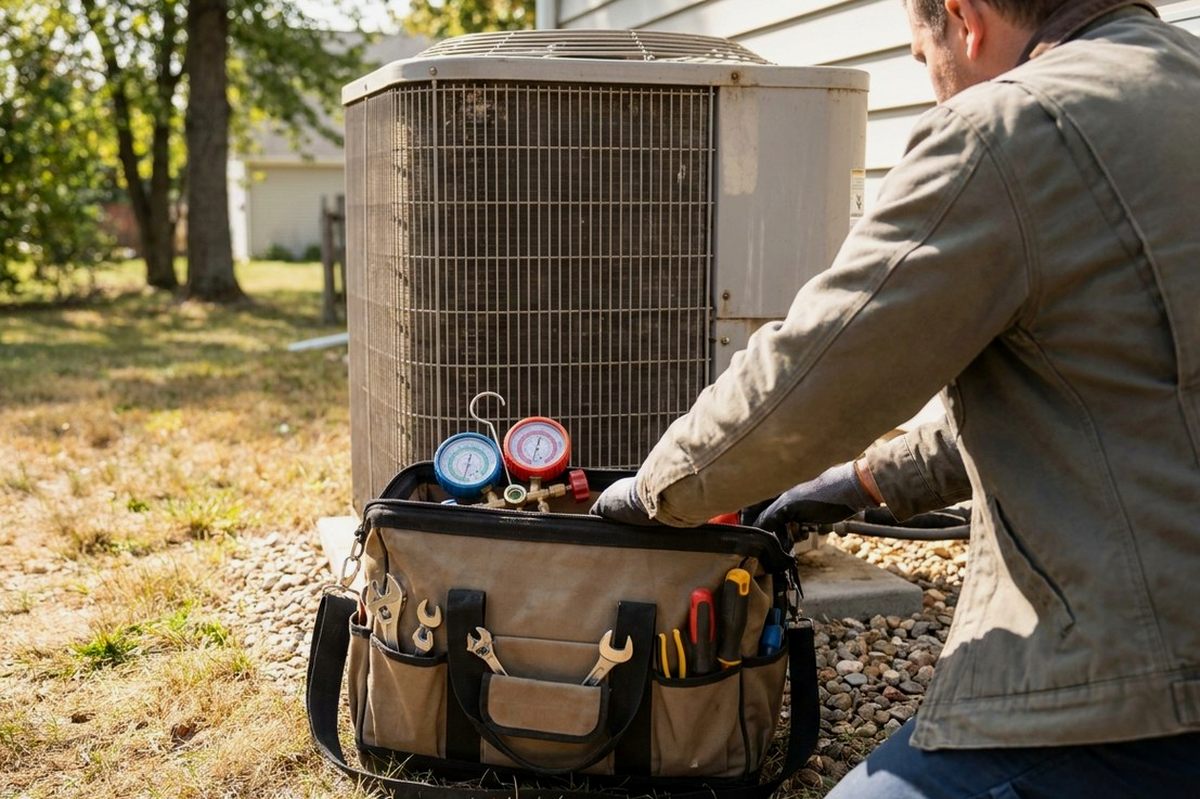
When we come out for heat pump or heating repair, we measure instead of guess. That means static pressure across the coil to prove whether airflow is the limit, temperature split between return and supply, suction and liquid pressures with outdoor conditions factored in, and amp draw on the compressor and any backup heat strips. We force a defrost cycle to confirm the board, sensor and reversing valve all respond. We also check the coil for salt corrosion and the pad for standing water, both common near the water. Then you get a plain explanation of what is failing and what it takes to fix it.
Heat Pump Running Nonstop in Cold Weather — what people ask
Is it bad for a heat pump to run all day in winter?
No. Continuous operation in cold weather is how heat pumps are designed to work, and steady running is easier on the equipment than constant starting and stopping. The concern is running nonstop while the house keeps getting colder.
Why is my heat pump blowing cool air?
Heat pump supply air is normally cooler than furnace air, so it can feel drafty even when it is working. It also blows cool briefly during defrost cycles. Air that is genuinely cold for long stretches needs a technician.
Should I switch to emergency heat when it gets cold?
Generally no. Emergency heat runs expensive backup strips and locks out the compressor entirely. Use it when the heat pump has clearly failed or the outdoor coil is solid ice, then call us for air conditioning and heating service.
How it works
- Step 1
Tell us the symptom
Call or fill in the quote form. We ask what changed, when it started, and what the thermostat reads against the actual room temperature. That short conversation tells us what parts to load on the truck.
- Step 2
We diagnose on site
A technician checks the thermostat, the electrical side, airflow through the filter and coil, refrigerant behaviour and the outdoor unit. You get a plain explanation of what failed and why, before any work starts.
- Step 3
Repair and verify
We make the repair, then run the system through a full cycle and measure temperatures at the supply and return. If something upstream caused the failure, we tell you so it does not repeat.
- A real person answers
- Open 7 days
- Written quote before work starts
Why homeowners call us
- We know salt airCoastal homes lose condenser coils to salt corrosion years before inland systems do. We look for fin damage and pitted line sets on every visit, because a clean-looking unit can still be shedding capacity from the outside in.
- Humidity is part of the jobHurricane-season air loads a system in ways a temperature reading will not show. If your house feels clammy at 74 degrees, we look at run times, airflow and drainage rather than just adding refrigerant and leaving.
- Crawlspace realitiesHigh water tables mean wet ground under ductwork, rusted plenums and condensate lines with nowhere good to drain. We check what is happening under the floor, since that is often where comfort problems actually begin.
- Straight answersWe tell you what failed, what it will take to fix, and whether a repair makes sense on an older system. No pressure to replace something that has honest years left in it, and no vague diagnosis.
- All major brands, gas & electricIndependent service on Carrier, Trane, Lennox, Goodman, York and the rest.
- Straight answersWhen a replacement beats a repair, we tell you, sometimes before we roll a truck.
About this guide
Past the safe checks, it's a job for tools and a meter
Tell us what you tried and what it did. The booking itself takes a minute.
- A real person answers
- Open 7 days
- Written quotes
- All major brands
- Gas & electric
Rather not call? Get a free quote →