
The independent heating and cooling company across Hampton Roads and coastal Virginia
Air Conditioner Blowing Warm
Your AC is running, you can hear the outdoor unit, and the air coming out of the vents feels like room temperature or worse. That is one of the most common calls we get across Virginia, Maryland, Delaware, the Carolinas and the rest of the region. Some of it you can check in five minutes. The rest needs a technician with gauges.
Call (888) 381-2953- A real person answers
- Open 7 days
- Written quote before work starts
Taking calls until 5:00 PM ET
By our service team · vetted by the techs who do this daily
What Warm Air Actually Tells Us
Warm air at the vents means one of two things: the system is not moving heat outside, or it is not moving air properly through the house. Cooling works by pulling heat out of your indoor air, carrying it in refrigerant, and dumping it outdoors. Break any link in that chain and you get airflow without cooling. That is why we ask two questions on the phone. Is the outdoor unit running, and is air coming out of the registers with normal force? Strong airflow with warm air points one direction. Weak airflow with cool-ish air points another. Both are fixable, and the cause is often cheaper than homeowners expect.
Cause Family One: Settings, Power and Airflow
Start with the cheap stuff, because it is genuinely common. A thermostat bumped to heat or fan-only will blow room-temperature air all day. Dead thermostat batteries can leave a screen on while the cooling call never goes out. A tripped breaker on the outdoor unit leaves the indoor blower running alone, which feels exactly like warm air from every vent. A filter packed with dust and pet hair chokes airflow until the indoor coil frosts over, and a frosted coil stops cooling completely. In our humidity, filters load up faster than the calendar suggests. We see one-inch filters that should have been changed a month earlier.
Cause Family Two: The Outdoor Unit and Salt Air
The condenser outside has to reject heat into already-hot, already-humid air. Grass clippings, cottonwood fluff, mulch and shrub growth packed into the coil act like a blanket, and the system loses capacity fast. Along the coast, salt in the air corrodes aluminum fins and eats at the coil surface over the years, which reduces heat transfer even when the coil looks clean. A failed condenser fan motor or a bad capacitor will let the compressor hum without airflow across the coil, and the system trips out on high pressure. You can clear leaves and trim back plants. Electrical parts inside that cabinet are ours to handle.
Cause Family Three: Refrigerant, Compressor and Controls
If the system is clean, powered and breathing well but still blowing warm, we are usually looking at refrigerant charge, the compressor, or a control failure. Low refrigerant always means a leak somewhere, because it is a sealed system and nothing burns off. Common leak points are the evaporator coil, service valves, and line-set connections, and crawlspace lines in high water table areas take a beating from moisture and corrosion. A worn compressor can run and draw current without pumping. Contactors, capacitors and low-voltage wiring also fail in ways that mimic every other problem. None of this is homeowner territory, and refrigerant work is not something to try at home.
What You Can Safely Check Before You Call
Keep it to five things. Confirm the thermostat is set to cool with a target below room temperature, and swap the batteries if it takes them. Check your electrical panel for a tripped breaker and reset it once. Pull the filter and hold it up to a light, and if you cannot see through it, replace it. Walk outside and clear leaves, clippings and weeds back a couple of feet from the outdoor unit. Walk the house and open any closed supply vents. If those come up clean, stop there and call us for air conditioning repair. If you ever smell gas near heating equipment, leave the building, call 911 or the gas utility from outside, then call us.
What a Technician Does Differently
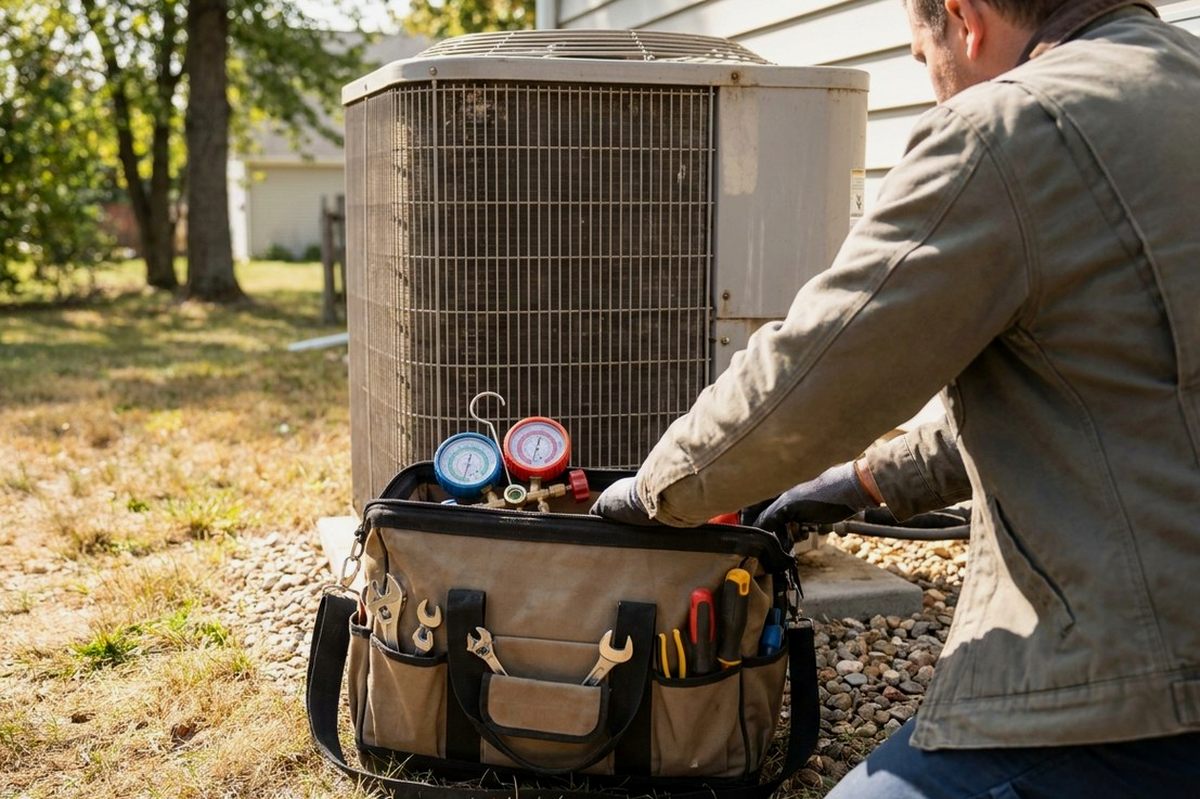
We measure instead of guessing. Gauges on the service ports tell us actual pressures, and with temperature readings we work out superheat and subcooling, which is how we know whether the charge is right or the metering device is restricted. We check amp draw on the compressor and fan motor against the data plate, test capacitors under load, and read temperature split across the indoor coil. We inspect the coil for oil residue that marks a leak, look at the drain and pan in humid weather, and check duct connections in crawlspaces. Then we tell you what failed, what it takes to fix, and what to expect from the rest of the system.
When it is time to book
Air Conditioner Blowing Warm — what people ask
Why is my AC running constantly but blowing warm air?
Usually the indoor blower is working while the cooling side is not. Common causes are a tripped breaker at the outdoor unit, a failed capacitor or fan motor, a frosted indoor coil, or low refrigerant from a leak.
Should I turn the AC off while I wait for a technician?
Yes, switch it to off rather than letting it run. If the indoor coil is frozen or the compressor is struggling, continued running can cause more damage. Set the fan to on if you want air movement.
Can a dirty filter really stop my AC from cooling?
It can. Restricted airflow drops coil temperature until ice forms, and an iced coil stops cooling entirely. Change the filter, leave the system off for a few hours to thaw, then restart and see if cooling returns.
How it works
- Step 1
Tell us the symptom
Call or fill in the quote form. We ask what changed, when it started, and what the thermostat reads against the actual room temperature. That short conversation tells us what parts to load on the truck.
- Step 2
We diagnose on site
A technician checks the thermostat, the electrical side, airflow through the filter and coil, refrigerant behaviour and the outdoor unit. You get a plain explanation of what failed and why, before any work starts.
- Step 3
Repair and verify
We make the repair, then run the system through a full cycle and measure temperatures at the supply and return. If something upstream caused the failure, we tell you so it does not repeat.
- A real person answers
- Open 7 days
- Written quote before work starts
Why homeowners call us
- We know salt airCoastal homes lose condenser coils to salt corrosion years before inland systems do. We look for fin damage and pitted line sets on every visit, because a clean-looking unit can still be shedding capacity from the outside in.
- Humidity is part of the jobHurricane-season air loads a system in ways a temperature reading will not show. If your house feels clammy at 74 degrees, we look at run times, airflow and drainage rather than just adding refrigerant and leaving.
- Crawlspace realitiesHigh water tables mean wet ground under ductwork, rusted plenums and condensate lines with nowhere good to drain. We check what is happening under the floor, since that is often where comfort problems actually begin.
- Straight answersWe tell you what failed, what it will take to fix, and whether a repair makes sense on an older system. No pressure to replace something that has honest years left in it, and no vague diagnosis.
- All major brands, gas & electricIndependent service on Carrier, Trane, Lennox, Goodman, York and the rest.
- Straight answersWhen a replacement beats a repair, we tell you, sometimes before we roll a truck.
About this guide
When the easy checks change nothing, it's time for a tech
Report what you saw during the checks and we handle the rest. A minute to book.
- A real person answers
- Open 7 days
- Written quotes
- All major brands
- Gas & electric
Rather not call? Get a free quote →